Friday, October 24, 2014

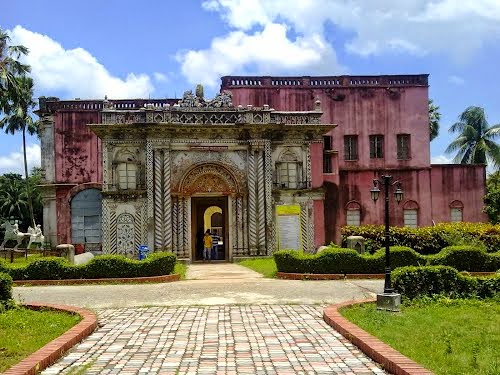
zamindar bari at Baliati

                                                 BALIATI ZOMIDAR BARI

The incredible Baliati Zomidar Bari(বালিয়াটি জমিদার বাড়ি) is found at the Saturia Upozila of Manikganj(সাটুরিয়া, মানিকগঞ্জ) area. Name of the town is Baliati. This archeological building is around 200 years of old. A stream named Gazikhali(গাজীখালী নদী) which is demised interval of the time, streamed at the northern side of the castle.

The entire reason is an enormous one(approximately 16000 square meter). There are potentially 200 rooms accessible inside the reason. Rear of the castle has a lake having four ghats(ঘাট). Opposite side of the lake has an arrangement of sterile restroom.

Gobinda Ram Shaha(গোবিন্দ রাম সাহা) was the pilgrim of the Zomidari(জমিদারী) at Baliati. He was a salt vendor. His ancestor was poor and began little business. Later he claimed that from his guardian. At that point he amplified that business further and made Zomidari(জমিদারী).

Unique name was Baliati(বালিয়াতি), yet in the wake of changing over into English, then name transgressed into Baliati(বালিয়াটি). This Jamidar family helped in training part extraordinarily. Dhaka Jogonnath(জগন্নাথ) University was made by them and the Jogonnath(জগন্নাথ) Hall of Dhaka University.

All the structures from the reason were not manufactured in the meantime. Those structures were constructed at diverse times by distinctive persons from the ruler's crew. A large portion of the structures are having a touch of Greek-Roman style, for instance the columns, top, and so forth. 


Instructions to go:

 There are a few approaches to take a swing at Baliati(বালিয়াটি).
1. To begin with you need to have a go at Saturia(সাটুরিয়া). GPS of Saturia(সাটুরিয়া) is (23°58'15.66"n, 90° 2'14.90"e).

** A transport from Gabtoli is accessible for Dhaka-Saturia course. You can take that one for 60 taka. It will oblige you around 2 hours to take a swing at Saturia(সাটুরিয়া).

** Or take a transport of Dhaka-Manikganj(ঢাকা-মানিকগঞ্জ) course from Gabtoli(গাবতলী), or Dhaka-Paturia(ঢাকা-পাটুরিয়া) administration of BRTC transport from Gulistan(গুলিস্তান). Transport passage is 70 taka. Following 1.5 hour get down from the transport at Kalampur(কালামপুর) Bus Stand. GPS of Kalampur(কালামপুর) is (23°55'4.52"n, 90° 9'16.16"e). From that point take a transport of Saturia(সাটুরিয়া). Transport charge is 20 taka and will oblige 20 minutes.

2. Utilizing a rickshaw for 20 taka from Saturia(সাটুরিয়া) bazaar, you can without much of a stretch go to the Baliati Palace. GPS of the Baliati Jomidar bari(বালিয়াটি জমিদার বাড়ি) is (23°59'40.79"n, 90° 2'32.72"e).

Where to Stay:

You can go there and return inside that day. So settlement is not required

Monday, October 20, 2014

Star Mosque at old Dhaka

                                                             STAR MOSQUE

Star Mosque is situated in Abul Khairat Road, Armenitola, in the old part of Dhaka City. The mosque is not dated by any inscription. It is known that one Mirza Golam Pir, whose ancestors had come to Dhaka and settled in Mohalla Ale Abu Sayeed (present-day Armanitola), erected it. Mirza Golam Pir died in 1860, and hence the date of construction of the mosque may conveniently be placed in the first half of the 19th century.


Originally it was an oblong (10.06m × 4.04m) three-domed mosque. There were three mihrabs on the Qibla wall in alignment with the three doorways of the mosque, of which the central one was larger than the side ones. The prayer chamber was roofed with three domes, the central one being taller and larger than the other two. The domes are carried in the interior on squinches. The original mosque building was not as decorated as it is now. The dilapidated plain and naked wall of the western side bears witness to the plainness of the past. The three southern doorways of the mosque are no doubt the old ones.
In 1926 a local businessman named Alijan Bepari added a verandah to the mosque on its eastern side, thereby almost doubling the width of the mosque without changing its original plan. Five arches were erected on four pillars on the eastern facade of the verandah. He also financed its resurfacing with delicate and richly coloured tiles of variegated patterns.

In 1987 the three-domed mosque was transformed into a five-domed mosque. At present, the length and breadth of the mosque is 21.34m and 7.98m respectively. Some changes took place in its plan; one mihrab was demolished and two new domes and three new mihrabs were added. Five arched doorways provide entrance to the mosque. The multifoiled arches spring up from octagonal pillars.
The mosque, both inside and outside, is decorated with mosaic. Small chips of Chinaware-plate, cup etc and pieces of glass have been used for mosaic. This type of mosaic is called ‘Chini Tikri‘ work. Vase with flowers is an important decorative motif on the spandrel of the arches and elsewhere on the facade. Flower-vases, flower branches, rosset, crescent, star, and Arabic calligraphic writing have been used in the decoration of the mosque. The outer wall between the doors are decorated with the motif of Fujisan (Mount Fuji) on glazed tiles and a crescent-and-star design decorates the upper part of the facade. Hundreds of blue stars have been created on the domes of white marble. All over the mosque the motif of stars dominate the decoration and so the mosque is called the Star Mosque (Tara Masjid).

Hoseni Dalan at old Dhaka


Hoseni Dalan is another edifice from Dhaka. This is located beside the Nazim Uddin(নাজিমুদ্দিন) Road of Old Dhaka. It is believed as a Shia Shrine, and was built during 17th century. There is a pond in front of the building, and I found all the doors were locked to reach near the pond.


It was built by Sayyid Murad(সৈয়দ মুরাদ) during the governorship of Shah Shuja(শাহ সুজা) to commemorate the martyrdom of Al-Hussain(আল-হোসাইন), the grandson of our holly prophet Muhammad. Shah Shuja was a Sunni Muslim, but he had a predilection for Shia and patronized several such institutions.


This building has gone through several renovation and none of it's antiquity left for the visitors. People only used to visit this place for it's historical value. During the British period it was repaired heavily at 1807 and 1810. Also during the massive earthquake of 1897 caused a severe damage over this edifice. Now a days it just looks like a modern day's building covering with rich tiles with heavy ornate.


During the first 10 days of Muharram(মহরম), Shia people used to gather at this place to mourn for Al-Hussain. Though its a festival of Shia people, but local Sunni people used to join with them and bemoan with them. This ends at the day of Ashura(আশুরা)

It's easy to locate this place. Just few minutes of walking distance from Doyel Chattar(দোয়েল চত্তর) of Dhaka University. Any rickshaw from that circle will lead you towards it. Exact Google map coordinate for the location is (23°43'20.52"N, 90°23'52.60"E

Panam City in Narayanganj


Panam City is known as "the lost city". It is situated at Sonargaon Upazila of Narayanganj District. Panam city was built by the upper-middle class Bengali businessmen, mainly Hindu cloth merchants, in the 19th century. It was built in the once capital of Bangladesh, Sonargaon. This city is now in ruins. In the last of 19th century, Panam city was built in Sonargaon. That time, business of cotton and other cloths were developed based on the Panam city. That time, Sonargaon got it heritage back a little. In the first part of the 20th century, some rich Hindu businessmen started to live permanently in the city. The still remaining ruins of the buildings were the residence of those businessmen. In those days, no city at the east Bengal was near as wealthy as Panam. All the buildings in the city were built facing a single road, which is 5 meters long and 600 miter wide. There still remain 52 buildings. The whole city is surrounded with artificial canals. These canals were dug to protect the city from any outside attack. There was only one bridge to enter the city in the west side. Back of every building is a pond. These ponds were used for household works. After the 1965 war of India-Pakistan, Hindu businessmen started to leave, and the city was deserted. World monument fund listed Panam city in the World 100 ruined city in 2006.


How to go:

Bus services are available to there from Gulistan, Dhaka. It will take around 1 hour to reach at the place. You have to get down from the bus at Mograpara Crossing. From the crossing, you have to take a rickshaw to reach at the ancient city, it will cost round about 20 Taka. It will be wise to start walking from the western part of the Panam city, and then move forward to eastern side until you reach to the end of the city. This is a very short path. So you can move slowly by watching the old building structures. If you have a camera you will be busy in taking photographs, that’s for sure. Also you can enter the narrow paths (path between two buildings) to watch the buildings from the back side. These buildings are controlled by the Bangladesh government and looks like they are doing it well. The area is very neat and clean. You'll find like as if you are in an unknown area. While walking through the Panam city, sometimes you'll find no one at anywhere, and it will give you a different feel. Take as much time as you can, no hurry, move slowly, and enjoy yourself.


Lok Shilpa Jadughar (Folk Art and Craft Museum) of Sonargaon was established by Bangladeshi painter Joynul Abedin on March 12, 1975. The house was built in 1901, originally called Bara Sardar Bari.


Sonakanda Fort is a Mughal river-fort located on the bank of the Shitalakshya River at Bandar, Narayanganj.


Khasnagar Dighi is a lake in Khasnagar village.

Sonargaon in Narayanganj


Sonargaon – The once capital of Bengal, is a place where you can see the country’s heritage. The main place to visit here is the Folk Arts and Crafts museum located inside the Folk Arts and Crafts Foundation premises, the nearby old city from colonial period – Panam, and the beautiful Goaldi Mosque from the sultanate period. 

Ticket: 

Ticket price for entering the foundation premises is 15 tk. for locals and 100 tk. for the foreigners. You do not need any separate ticket to enter the museum.


Parking:

Adjacent to the foundation is the newly renovated car parking area. The area is big enough to park lots of cars and buses. The charge for parking is as follows (no time limit):
  • Cars, SUVs, Vans (NOAH/HIACE): 50 tk.
  • Coaster: 75 tk.
  • Bus: 120 tk.
  • Baby Taxi: 20 tk.
  • Motor Byke: 15 tk.
  • Bicycle: 5 tk


Boat Riding:

There is arrangement of riding in boats on the lake inside the foundation premises. Ticket price for boat riding is 20 tk. per person for 30 minutes.


Fishing:

You can do fishing by hook on the lake. Price is 1,500 tk. for a whole day. You have to bring your own hook.


Picnic:

There is place inside the foundation premises to organize picnic. Contact the foundation for price details.


Shooting of film:

For shooting inside the foundation premises, the charge is 5,000 tk. for a whole day.


Visiting Hours of Sonargaon Museum:

  • Friday – Tuesday: Foundation premises is open from 9 am – 5 pm, and the museum is open from 9.30 am – 4.30 pm. Museum galleries are closed at 12.30 pm – 2.30 pm at Friday only for the Jum’a prayer.
  • Wednesday & Thursday: Closed.
  • Government holidays: Closed.

Sunday, September 28, 2014

National Assembly of Bangladesh


If we look at the history of architecture since its beginning, say from the time of the pyramids to modern times, and make a list of the most significant buildings, it is likely that the National Assembly of Bangladesh (also known as Sher-e-Bangla Nagar) will occupy quite a prominent position. One could say that it was the culmination of the modern period of architecture and the beginning of the post-modern era.

The decision to build the National Assembly of Bangladesh in Dhaka city was originally made in 1959. The administrators of martial law planned to build the current Sangsad Bhavan as a second seat of parliament of Pakistan on the proposed zone as the second capital, Sher-e-Bangla Nagar.


Kahn, one of the great architects of his time, was originally selected to design the compound of the National Assembly. He was not charged directly, but the project was put to the public to submit preliminary ideas for the complex and in March 1962 he was awarded the project officially.

An extension of 208 acres north of the current Manik Mia Avenue was destined for the draft's second capital in 1961 and the masterplan was completed in 1962. Construction began in 1964 with an initial cost of $15 million. The main structure was under construction in 1971 when war erupted in the area and all work stopped. In 1974 the government of Bangladesh made the decision to terminate the project under its original plans. The construction of the complex, along with all its services and facilities, was completed and inaugurated in 1982 at a cost of $32 million.
The biggest criticism that has gone to the building has been for its exorbitant construction, especially in maintenance. The total cost of the complex (including the parliament building, the plaza north, the plaza south, residential buildings, hotels, gardens, streets, lakes, etc.) ascended to the staggering figure of $1.28 million. The mega complex has no more nor no less than 50 flights of stairs, 240 bathrooms, 1,635 doors, 335 windows, 300 partitions, and thousands of square meters of glass panels and wood. The annual cost of maintaining these facilities amounted to $55 million.
The building of the National Assembly has been addressed in virtually all publications about architecture around the world and has also been awarded the prized Aga Khan Award for Architecture. The subpoena that follows took place at the ceremony in which it awarded the construction and expresses a very interesting project evaluation:
"Faced with an architecture of so much power, size, clarity and beauty, the jury was unable to avoid questioning the compatibility between Sher-e-Banglanagar with the needs and aspirations of a poor country like Bangladesh. Yet studies on the design and construction of the building revealed that over time it has gained general acceptance and has become a symbol of democracy in Bangladesh, influencing the country in many positive ways. Looking at its architecture spatially, more immediately the building has been able to absorb major archetypes of the region along the street and its extensive gardens and numerous lakes. The architect has managed to reinterpret and transform these ideas along a process that has been able to adapt concepts of construction and technology to the specific conditions of the locality of Dhaka. The result is a building that, while universal in its concept and method, could not be found anywhere else."

Thursday, September 25, 2014

Ahsan Manjil in Dhaka


Built in 1872 and standing on the river Buriganga, this stately building offers the visitors a feeling of the life-style of the Nawabs of Dhaka. Sometimes known as the Pink Palace, this building now houses a splendid museum.Basically, it was the residence of the Nawabs. Nawab Abdul Gani renovated this building in the year 1872  and named it after his son Khaza Ahasanullah. 

On the bank of river Buriganga in Dhaka,the Pink majestic, Ahsan Manjil has been renovated and turned into a museum recently. It is an epitome of the nation's rich cultural heritage.


Todays renovated Ahsan Manjil a monument of immense historical beauty.

It has 31 rooms with a huge dome atop which can be seen from miles around. It now has 23 galleries in 31 rooms displaying of traits, furniture and household articles and utensils used by the Nawab.


Open 9 am- 5 pm from Saturday to Wednesday and 3-5 pm on Friday.

Thursday is close.